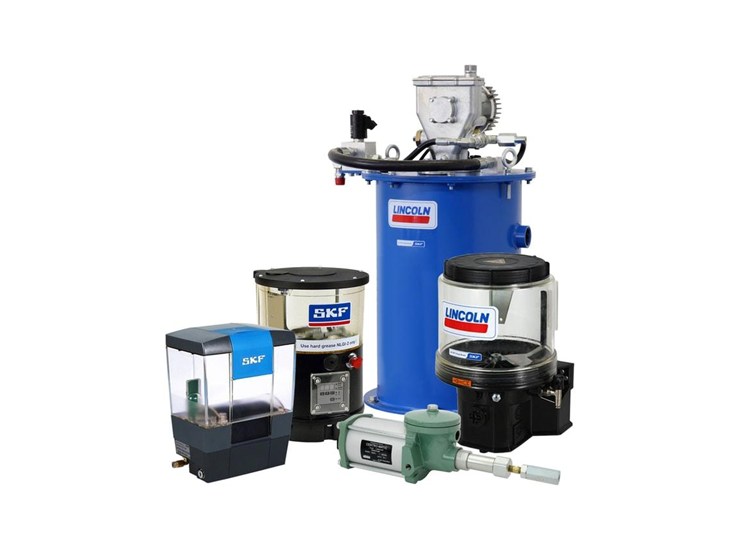
SKF Lincoln offers world-class lubrication solutions designed to enhance equipment performance, reduce downtime, and extend component life. SKF Lincoln systems are engineered to deliver precise and consistent lubrication across a wide range of industrial, mobile, and heavy-duty applications.
Founded in 1907 in Gothenburg, Sweden, SKF (Svenska Kullagerfabriken) is a global leader in bearing and lubrication technologies, with operations in over 130 countries.
Enquire NowIdeal for large installations with widely distributed lubrication points requiring varying lubricant quantities. The system operates with two main lines alternately supplied by a high-pressure pump (up to 400 bar) via a change-over valve. Dual-line metering devices ensure precise, individually controlled delivery to each point, supplying up to 2,000 points over long distances. The system is flexible and easy to expand or modify without redesign, and keeps operating reliably even if one metering outlet becomes blocked.

Electric pumps for dual-line lubrication systems, operating at pressures up to 400 bar and supplying lubricant over distances of up to 120 m or more depending on layout. Available with 40 L or 100 L reservoirs, they include a pressure relief valve, check valve, filter and pressure gauge as standard. The robust design operates from −20 °C to +80 °C, with high lubricant output options, ultrasonic level control and easy servicing. Typical applications include cement plants, steel mills, power plants, mining and large industrial machines.
Durable galvanized steel units for dual-line systems operating up to 400 bar, available with up to eight outlets, each pair fitted with indicator pins for visual monitoring. Optional proximity switches or piston detectors enable electrical monitoring. The solid-block design ensures high durability across a wide temperature range, with horizontal (VSKH) or vertical (VSKV) outlet configurations for flexible installation.
Monitoring devices generate visual or electrical signals analysed by electronic control systems to give real-time feedback to operators or machine controls. They monitor lubricant level, pressure and flow, and track lubricant volume, oil–air mixtures and filter contamination. Additional monitoring covers movement indicators, reservoir and bearing temperature, and moisture in lubricants — enabling early fault detection and safe machine operation.
Control units manage lubrication cycles and idle times and evaluate key system parameters. In case of faults, visual or electrical signals alert the operator to take corrective action, protecting the machine from damage. In oil circulation systems control is usually integrated with the machine's main control unit, and remote control and monitoring software is available. Monitored parameters include cycle timing, pressure, lubricant quantity and level, and number of cycles.