Choosing a Coupling: Misalignment, Shock Loads and Torque
Power Transmission
January 22, 2026
Couplings are often specified last and replaced like for like, which is how a drive train ends up with a component that was never right for the duty. The coupling has to transmit torque, absorb whatever misalignment the installation actually has rather than the alignment the drawing shows, and cope with the shock loads the driven machine produces.

“Specify the coupling for the misalignment you will really have, not the alignment the drawing promises.”
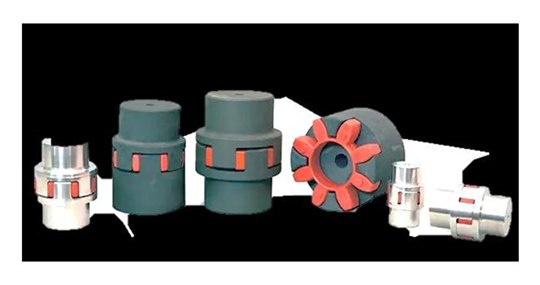
Flexible jaw couplings, with an elastomer spider between two hubs, are the common starting point. They damp vibration, tolerate modest misalignment and are simple to install and service — the spider is a wear part that can be replaced without moving the connected machines. Spider material sets the temperature and torque window, so it is worth checking rather than assuming.
Where shafts are widely separated or misalignment is larger, all-steel gear couplings take over. They handle axial, radial and angular misalignment together and transmit very high torque, with grease lubrication and O-ring sealing giving long service between interventions.
When Standard Types Are Not Enough
Some duties need a coupling that does more than transmit torque. Backlash-free servo couplings suit positioning applications where any lost motion is a problem. Overload protection couplings disconnect the drive at a set torque, protecting an expensive gearbox from a jam. Magnetic and fluid couplings transmit power without direct contact, which is useful for sealed or soft-start applications.
For hazardous areas, ATEX compliance matters, and for anything unusual it is often quicker to have a coupling modified than to force a standard part to fit. Design modifications and prototypes are routine work for coupling manufacturers — the mistake is not asking.